
Your coach shows an armbar from guard. You drill it for ten minutes, it feels fine, you go home. Thursday you roll, the exact position turns up — and you have nothing. Not a half-memory. Nothing.
Every white belt thinks this means something is wrong with them. It doesn't. You're being shown three or four techniques a session, each with half a dozen details, in a position your body has no experience of. Forgetting is the default. Remembering is the thing that takes a method.
Here's what actually works, roughly in order of how much it's worth.
Give it a name
This is the one that changed things for me, and it costs nothing.
A technique you can't name is a sequence of sensations with no handle on it. You can't go looking for something you can't call anything. So name it — out loud, in your own words, before you leave the mats. "Hip bump to kimura." "Knee shield, underhook, come up."
It does not matter whether your name matches what the rest of the world calls it. If the detail that makes it work for you is the way you pin the far wrist, call it the wrist-pin armbar. The name is a retrieval handle, not a label for anyone else. What matters is that it's consistent — same technique, same name, every time — so that each repetition stacks on the last instead of starting over.
Then attach the name to the trigger, not just the move. "When he posts his hand on my hip" is more useful than "armbar", because the trigger is what you'll meet in a roll. The move is what you want to arrive.
The notebook works — but not the way most people use it
Plenty of people keep a training diary. Most of them get a fraction of what it's worth, because they treat it as a record.
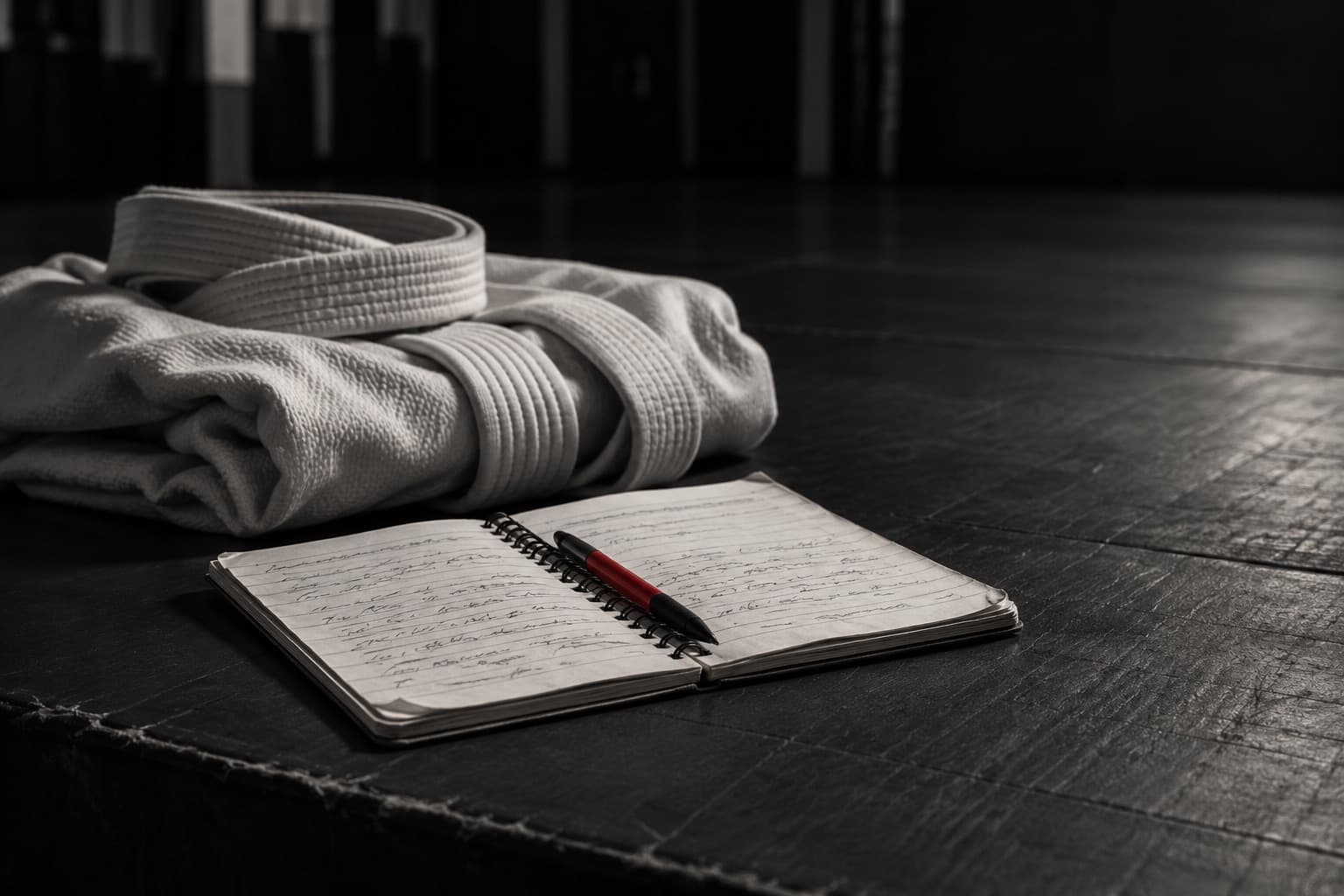
You can't take a notebook onto the mats. That sounds like the limitation, and it's actually the point. The value was never in reading it back — it's in the writing, because writing forces you to drag the technique out of your head unaided. That act of struggling to recall something is, as far as anyone can tell, the single most effective thing you can do to make it stick. Re-reading your notes feels far more productive and does considerably less.
So write it the hard way:
- Before you check anything, write the technique from memory. No video, no asking a training partner.
- Write the gaps as gaps. "Something with the far leg — can't remember what" is a more useful note than a smooth description you half-invented. It tells you exactly what to ask next session.
- Do it a few hours later, not in the car park. If you can still get it at nine o'clock that night, you actually have it.
- Three or four lines. A paragraph per technique is a diary. A page per technique is a project you'll abandon by March.
Then close it. Try again the next day before you look. The forgetting and the effortful re-remembering is the mechanism — it isn't a sign the system is failing.
Pick one thing, not everything
A class gives you four techniques. You will keep about one. You can either choose which one, or let chance choose for you.
So choose before class ends. One technique, or honestly just one detail of one technique — the grip, the angle of the hips, where the head goes. Decide that's the thing you're taking home, and let the rest wash over you. Trying to hold all four is how people end up with none.
The ones you let go aren't wasted, either. You'll see them again, and the second time they land on ground that isn't completely bare.
Use it the same night
Drilling a technique is rehearsing it. Using it in a live round is learning it.
If there's positional sparring at the end of class, spend it hunting the thing you just learned — even if that means losing positions you'd otherwise hold. Getting it wrong against someone who's resisting teaches you more about where it actually breaks than another twenty clean reps on a compliant partner.
If your gym doesn't do positional rounds, make your own. Tell your partner what you're working on and ask them to start you there. Most people are happy to; they'd like the same favour next week.
Explain it to someone
Find the newest person in the room and walk them through it. You'll discover within about thirty seconds which parts you actually understand and which you were nodding along to.
You don't need to be senior to do this, and you're not pretending to coach. "Here's what I think I'm meant to do" is an honest sentence, and saying it out loud does more for your retention than another round would have.
Break it into three or four steps, not twelve
Nobody holds twelve steps. What experienced grapplers do — without really noticing — is hold three or four chunks, each of which unpacks into detail when they get there.
"Frame, angle, leg over, finish" is a thing you can carry around in your head. The same technique written as twelve micro-adjustments is a thing you can read. Write the chunks; let the detail live underneath them.
Sleep is the one nobody wants to hear
Motor skills consolidate while you're asleep. The practice puts it there in a fragile form and sleep is what makes it durable — which is why a technique can feel clumsy on Tuesday night and strangely less so on Wednesday without you touching it in between.
This is the largest single factor on this page, and it's the one people skip past looking for a supplement. A late class followed by five hours' sleep will cost you more retention than any amount of note-taking will win back. If you train at night, the most useful change available to most people is getting to bed sooner afterwards rather than scrolling off the adrenaline for two hours.
Food, and an honest word on creatine
We don't sell supplements, so take this as what it is — no stake in what you buy.
Eat before you train. Not a feast, but training on an empty stomach after a full day's work means the second half of class is spent surviving rather than learning. Something with carbohydrate an hour or two beforehand does the job.
Drink water through the day, not just at the gym. Dehydration takes the edge off concentration before you feel thirsty, and concentration is the whole game when you're trying to take a new detail in.
Protein across the day supports the recovery side. Nothing exotic — if you're eating enough and sleeping enough, you're ahead of most of the room.
Creatine monohydrate is worth a straight answer, because it's the one that gets asked about and the one most oversold. It is genuinely among the best-evidenced supplements in sport for training output — strength, repeated efforts, the kind of work a hard round asks for. Three to five grams a day, taken whenever suits. The loading phase you'll read about isn't necessary; it just gets you there faster.
The memory angle is where honesty matters. There is research on creatine and cognition, and it's promising rather than settled — the clearest effects turn up in people who are sleep-deprived or who eat little or no meat, which is to say in people who were short of it to begin with. If you're well-fed and sleeping properly, don't expect it to do much for your recall. Take it for the training benefit, and treat anything else as a bonus you can't count on.
Caffeine before an evening class is a trade. It'll sharpen the session and it may cost you sleep, and sleep is the thing doing the consolidating. If you train at night and struggle to get down afterwards, that trade is a bad one.
Usual caveat, meant sincerely: if you've got a medical condition, take medication, or you're pregnant, run supplements past a doctor or dietitian rather than a gi website.
Film it, if your gym is fine with it
Thirty seconds of your training partner doing the technique, shot at the end of class, is worth more than a page of notes for anything spatial — where the hips go, what the angle looks like from outside.
Ask first. Some gyms are relaxed about it, some aren't, and nobody enjoys being filmed without being asked. And film the technique, not your rounds — a folder of 400 unwatched sparring videos is a hobby, not a study method.
It gets easier, and not for the reason you think
Blue belts don't have better memories than you. They have more hooks to hang things on.
When you've seen fifty guard passes, the fifty-first is mostly a variation on things already in your head — you're storing a difference, not a whole new movement. At white belt everything is new, so everything has to be stored from scratch. That's why it feels so much harder for you than for the people around you, and it's also why it stops feeling that way.
You don't have to do all of the above. Name the technique, write three honest lines that night, and go to bed at a reasonable hour. That alone will put you ahead of where you'd otherwise be by a distance — and it costs you about four minutes a session.
Nothing here is medical or dietary advice. Roll BJJ doesn't sell supplements and has no commercial interest in whether you take any.