
Nothing ruins a comp day faster than being turned away at the gi check. The frustrating part is that it's almost never a surprise — the inspectors work from a short list of measurements, and you can check every one of them at home with a tape measure the week before.
Here's that list. All of it comes straight from the IBJJF's own uniform page rather than second-hand, because the rules changed after the 2024 Gi World Championships and a lot of what's still floating around online is out of date.
The measurements they actually check
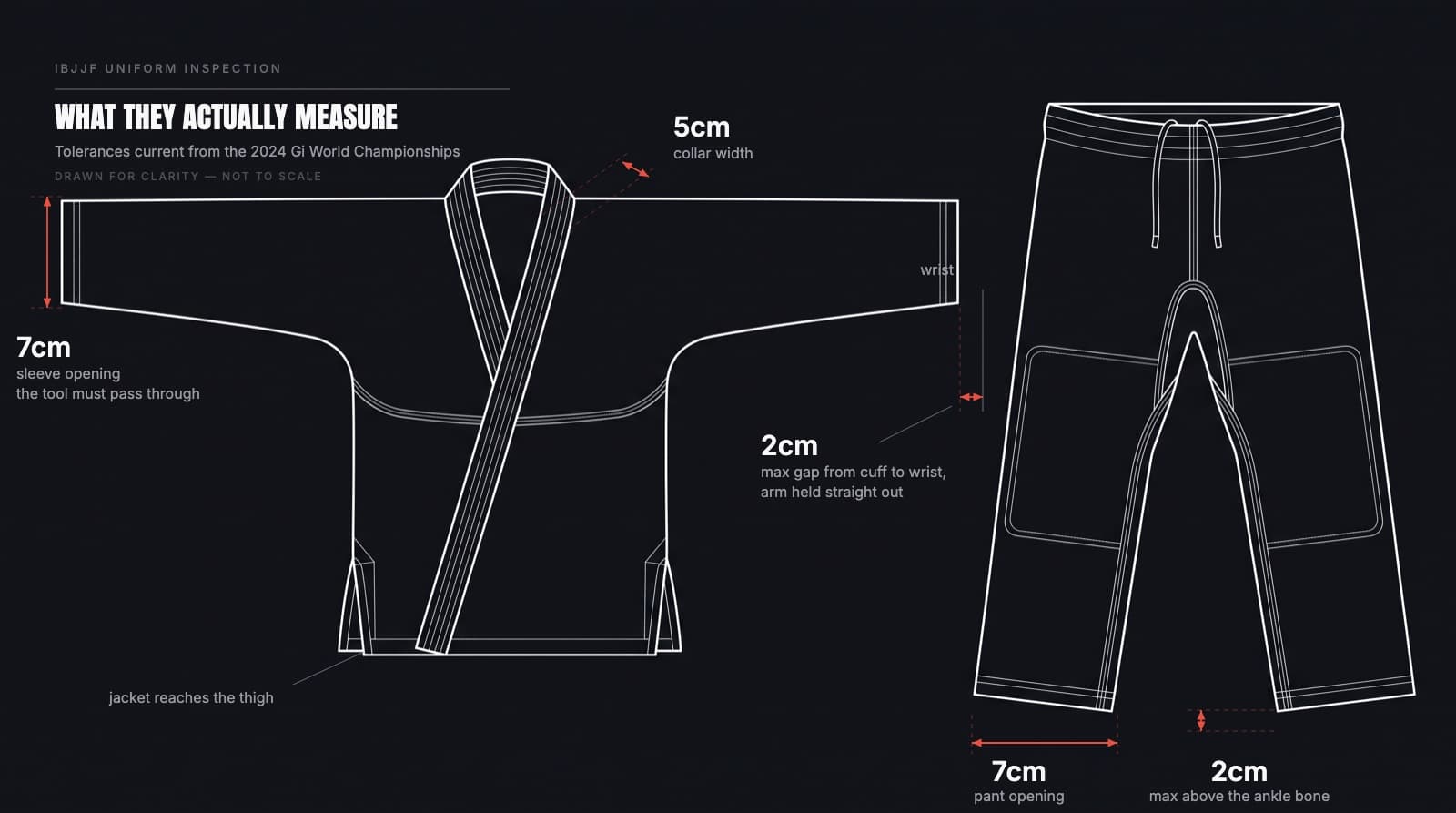
Gi inspection uses a physical tool with three official measurements:
- Sleeve opening: 7cm. The tool has to pass through the cuff with your arm fully extended.
- Collar width: 5cm.
- Lapel thickness: 1.3cm.
Then two length checks:
- Sleeves must finish no more than 2cm from your wrist, with the arm held straight out parallel to the floor.
- Pants must finish no more than 2cm above the ankle bone (the tibial malleolus).
That 2cm tolerance is the big one. It used to be 5cm. If you're competing in a gi you bought before 2025 and it fit the old rule with room to spare, measure it again — a sleeve that was fine two years ago may not be now.
The jacket also has to reach your thigh.
Colours: three, and no mixing
White, royal blue, or black. That's the entire list.
The jacket and pants must be the same colour, and the collar can't be a different colour from the rest of the jacket — that last one catches people out, because plenty of good-looking gis have a contrast collar.
Grey isn't legal. Neither is navy that isn't royal blue. If you're buying a gi specifically to compete in, buy one of the three.
Patches and printing
Patches must be cotton, properly sewn on, and only in the regions the rules book allows. Anything unsewn or in the wrong place gets removed by the inspectors — at the event, off your gi.
Painted gis are out, unless the paint forms an academy or sponsor logo and sits where a patch would be allowed. Even then, if the paint marks your opponent's gi during a match, you'll be told to change.
Worth knowing for anyone eyeing a gi with artwork: a printed inner liner is not a problem. It's inside the jacket, it doesn't sit in a patch region, and it isn't visible when you're wearing it. Our limited-edition gis are cut to competition spec for exactly this reason — the personality is on the inside where the rulebook doesn't reach.
Belts
4 to 5cm wide, in your rank colour, with a black tip — except black belts, where the tip is white or red.
Worn over the jacket, wrapped around your waist twice, tied in a double knot tight enough to hold the jacket closed. Once tied, each end should hang 20 to 30cm.
If your belt is so long the ends dangle past your knees, or so short it barely knots, that's worth sorting before comp day rather than on the mat.
What you can wear underneath
This one differs by division, and it's a common cause of confusion:
- Men: no shirt under the gi top. No pants under the gi pants.
- Women: a stretchy, body-hugging shirt under the top is mandatory — short or long sleeved, and it doesn't have to follow the colour rules. A one-piece swim garment or gymnastics top is also fine. Elastic pants under the gi pants are permitted, as long as they're shorter than the gi pants.
Everyone needs undergarments, and they have to be briefs — thongs aren't permitted.
The rule that isn't about measurements
A gi that passes every measurement can still be rejected for being wet, dirty, torn, or smelly.
This matters more than it sounds. If you're competing in multiple divisions, or it's a humid Queensland afternoon and you've already had three matches, a single gi can genuinely fail the second inspection of the day. Anyone competing seriously brings a second one.
Mending and tears count too — a repaired seam can fail even if it's structurally fine.
No-gi, briefly
Different rules entirely:
- Rash guard: skin-tight, long enough to reach the waistband of your shorts, coloured black, white, or black and white, with at least 10% of your rank colour. A rash guard entirely in your rank colour is also fine.
- Shorts: no pockets (or pockets sewn completely shut), no buttons, no zips, no exposed drawstrings, nothing plastic or metal. Long enough to cover halfway down the thigh, no longer than the knee.
- Compression shorts underneath are permitted in the same colours.
The rank-colour requirement is the one people forget. A plain black rash guard is not legal for a blue belt at an IBJJF event.
The night-before checklist
Tape measure, five minutes:
- Arm out straight — sleeve within 2cm of the wrist?
- Pants within 2cm above the ankle bone?
- Jacket reaches the thigh?
- Collar 5cm wide, lapel 1.3cm thick?
- Two fingers — near enough to 7cm — through the cuff?
- White, royal blue or black, matching top and bottom, collar included?
- Every patch sewn down and in a legal region?
- Belt ends hanging 20–30cm once double-knotted?
- Clean, dry, no tears. Spare gi packed.
Competition-legal gis, designed in Australia
Every Roll gi is cut to IBJJF specification — 380gsm pearl weave, ripstop pants, legal colours, and the artwork on the inside where it belongs.
One caveat worth repeating: the referee measures the gi on you. Two people the same height can carry that height differently, and a longer arm or torso moves where the cuff sits. Run the checklist above in your own gi, at home, with a week to fix anything — not in the bullpen.
Rules current as of August 2026 and sourced from the IBJJF uniform page. Federations other than the IBJJF set their own requirements, and local Australian promotions sometimes run more relaxed rules — always check the event's own page before you travel.